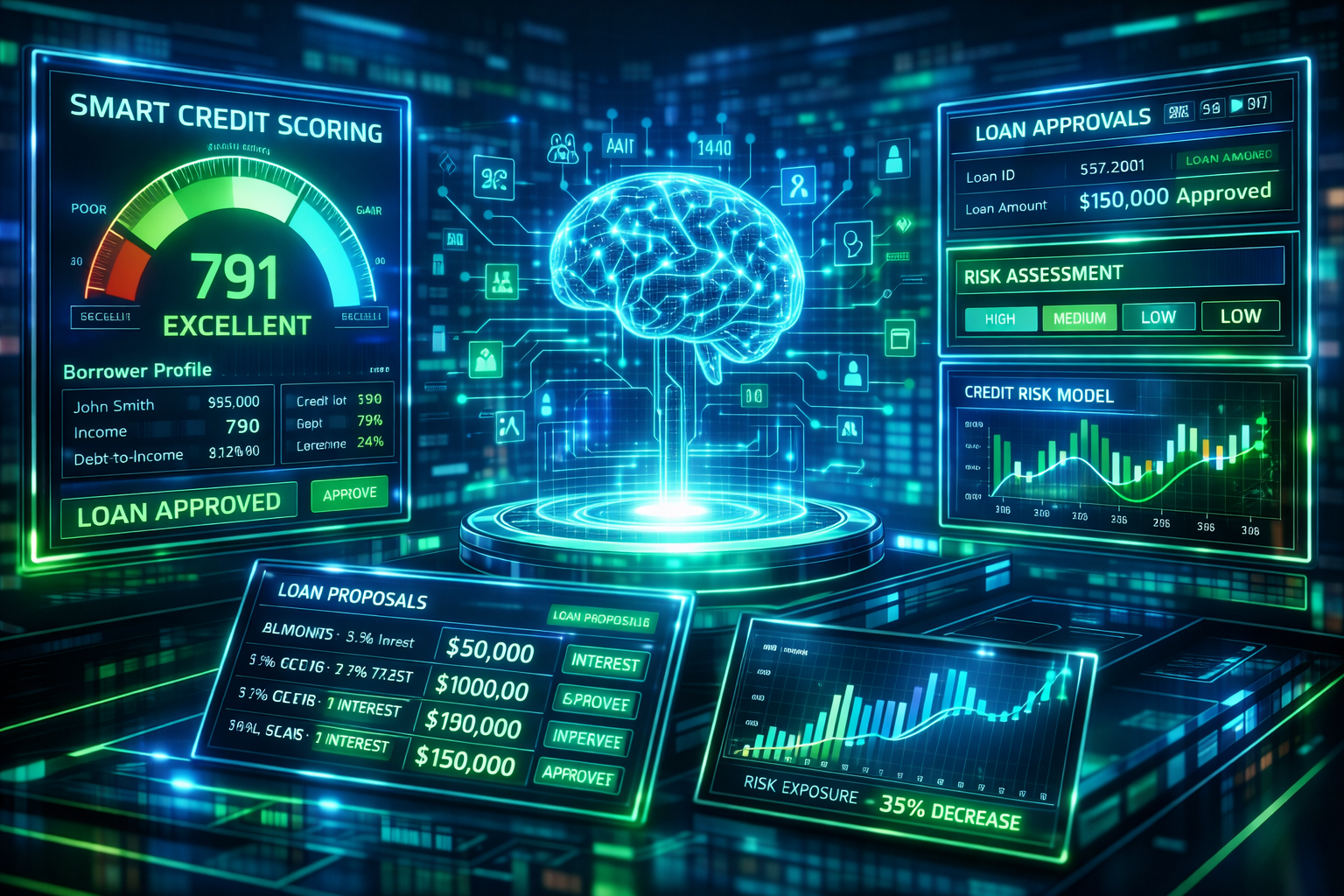
Fintech lending has emerged as one of the fastest-growing sectors in finance, offering faster, more accessible, and personalized loans to individuals and businesses. However, traditional credit scoring and loan approval methods are often slow, rigid, and dependent on limited data, leading to missed opportunities and higher risks.
Artificial intelligence (AI) is revolutionizing fintech lending by introducing smart credit scoring, predictive analytics, and automated decision-making. By analyzing vast datasets, AI provides accurate assessments of creditworthiness, reduces default risks, and enables instant loan approvals.
In this article, we explore how AI is transforming fintech lending, the technologies involved, applications, benefits, challenges, and the future of AI-driven smart credit scoring.
What Is AI in Fintech Lending?
AI in fintech lending uses machine learning algorithms, predictive analytics, and automation to analyze applicant financial behavior and credit history. Unlike traditional methods that rely on limited financial records, AI evaluates multiple factors, including transaction patterns, digital footprints, and alternative data sources.
Applications include:
- Smart credit scoring
- Instant loan approval
- Risk-based lending
- Fraud detection in loan applications
- Personalized financial recommendations
AI allows lenders to approve loans faster, reduce defaults, and provide better customer experiences.
Core AI Technologies in Fintech Lending
Machine Learning (ML)
ML models evaluate historical loan data, transaction patterns, and repayment behavior to predict creditworthiness accurately.
Predictive Analytics
Predictive analytics forecast potential defaults, risk exposure, and repayment probability, enabling data-driven lending decisions.
Natural Language Processing (NLP)
NLP analyzes unstructured data such as social media, emails, and application documents to provide additional insights for credit scoring.
Automation and Robotic Process Automation (RPA)
AI-driven automation handles repetitive loan processing tasks, KYC verification, and reporting, reducing human errors and processing time.
How AI Transforms Fintech Lending
1. Smart Credit Scoring
AI systems assess creditworthiness by combining traditional credit history with alternative data sources such as mobile payments, online transactions, and social signals. This enables financial inclusion for underserved customers with limited credit records.
2. Instant Loan Approval
AI automates decision-making by analyzing applicant data in real time, enabling near-instant loan approvals without compromising risk assessment.
3. Risk-Based Lending
AI evaluates borrower risk dynamically, allowing lenders to adjust interest rates, loan amounts, and repayment terms based on individual risk profiles.
4. Fraud Prevention
AI detects anomalies in loan applications, preventing identity theft, fraudulent claims, and synthetic identities from compromising lending portfolios.
5. Personalized Lending Solutions
AI provides tailored lending options and repayment strategies based on borrower behavior, financial goals, and credit profiles, enhancing customer satisfaction.
Benefits of AI in Fintech Lending
Improved Accuracy
AI minimizes errors in credit assessment and reduces the likelihood of defaults.
Faster Processing
Automated approvals and real-time analysis significantly speed up the lending process.
Financial Inclusion
AI enables access to loans for individuals and businesses with limited or no traditional credit history.
Risk Mitigation
Predictive analytics and fraud detection reduce exposure to bad loans and financial losses.
Cost Efficiency
Automation lowers operational costs, reduces manual labor, and enhances scalability for lenders.
Challenges of AI in Fintech Lending
Data Privacy and Security
AI systems require access to sensitive financial and personal data, necessitating strict security measures.
Model Transparency
Complex AI models may lack explainability, making it difficult to justify decisions to regulators or customers.
Regulatory Compliance
AI-driven lending must comply with evolving fintech regulations to avoid penalties and maintain trust.
Bias in AI Models
AI models may inadvertently favor or penalize certain demographic groups if training data is not diverse and unbiased.
Real-World Applications
- Online Lending Platforms: AI evaluates borrower creditworthiness instantly and approves loans in minutes.
- Digital Banks: AI-driven risk scoring and fraud detection protect portfolios while improving customer experience.
- Microfinance & Peer-to-Peer Lending: AI helps assess alternative credit data for small loans to underserved populations.
These applications demonstrate how AI is enhancing efficiency, reducing risk, and expanding access in fintech lending.
The Future of AI in Fintech Lending
AI will continue to redefine lending and credit scoring:
- Fully automated, AI-driven loan origination systems
- Integration with blockchain for transparent, secure loan tracking
- Personalized, predictive lending solutions for each borrower
- Advanced risk modeling to anticipate economic shifts and market volatility
By leveraging AI, fintech companies can scale faster, reduce defaults, and provide superior financial services to a wider audience.
Conclusion
AI is transforming fintech lending and smart credit scoring by enabling faster approvals, accurate risk assessment, fraud detection, and personalized lending. From traditional banks to online lenders and microfinance platforms, AI empowers financial institutions to make data-driven decisions and serve customers more effectively.
While challenges such as data privacy, model transparency, and bias remain, the benefits of AI-driven lending are clear. Financial institutions that adopt AI in lending will enjoy higher efficiency, lower risk, and better customer satisfaction, shaping the future of modern finance.