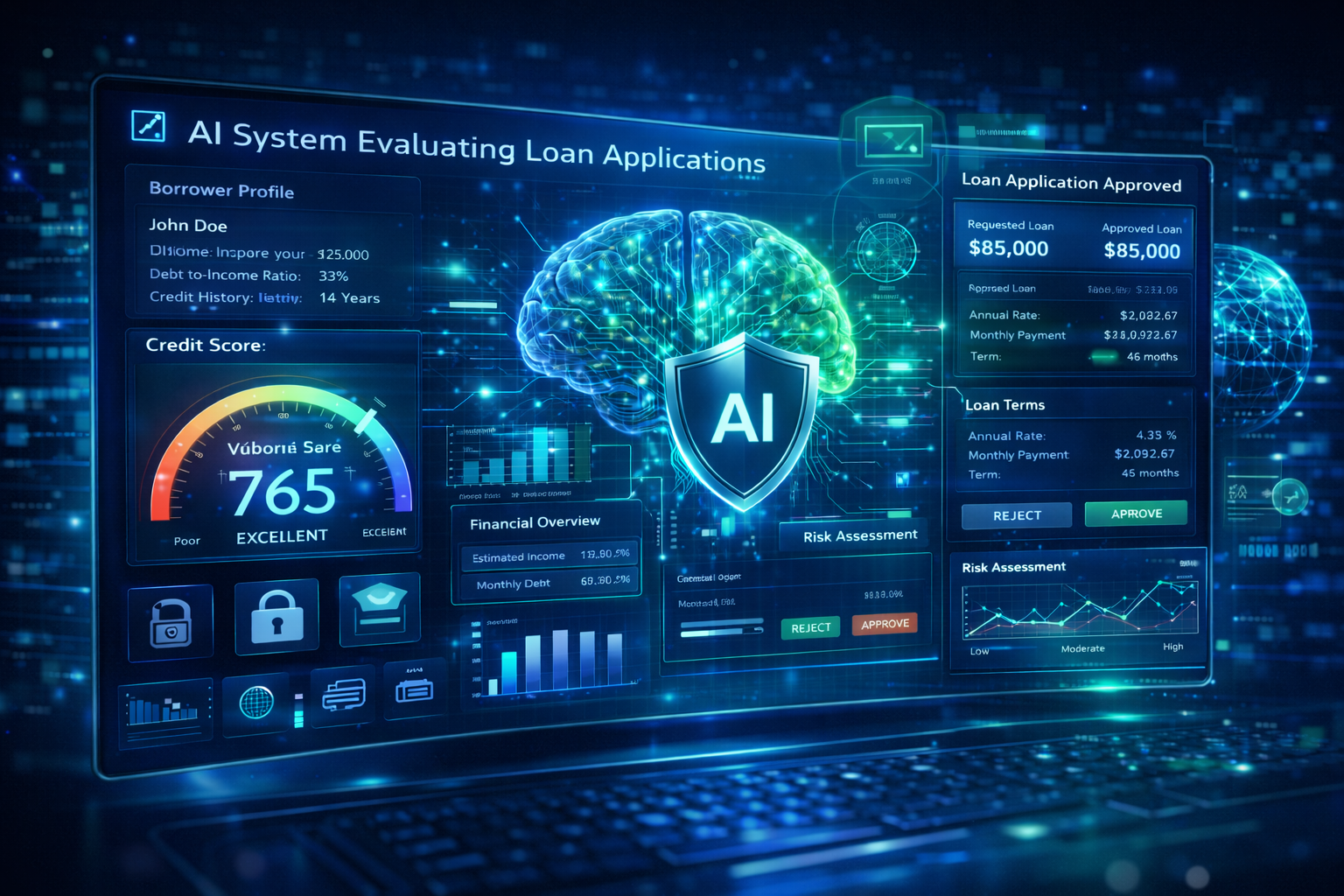
Credit scoring and loan approval are among the most critical processes in the banking and financial industry. Traditionally, banks relied on manual reviews and limited financial data to decide whether a customer was eligible for a loan. These methods were often slow, inefficient, and prone to human bias.
Today, artificial intelligence (AI) is transforming how financial institutions evaluate credit risk and approve loans. AI-powered credit scoring systems analyze vast amounts of data, generate accurate risk assessments, and enable faster, more inclusive lending decisions. As digital banking continues to expand, AI has become a key driver of innovation in lending and credit management.
In this article, we will explore how AI credit scoring and loan approval systems work, the technologies behind them, their benefits, risks, and why they are considered one of the highest-value applications of AI in finance.
What Is AI Credit Scoring?
AI credit scoring refers to the use of artificial intelligence and machine learning algorithms to evaluate a borrower’s creditworthiness. Unlike traditional credit scoring models, which rely on a fixed set of financial indicators, AI systems analyze a much broader range of data.
These systems assess patterns, behaviors, and trends to predict the likelihood of loan repayment. AI credit scoring models continuously improve as they process new data, making them more accurate over time.
Traditional Credit Scoring vs AI-Based Credit Scoring
Traditional Credit Scoring
Traditional credit scoring systems depend on:
- Credit history
- Income level
- Outstanding debts
- Payment records
While effective to some extent, these models often exclude individuals with limited credit history and may not accurately reflect real financial behavior.
AI-Based Credit Scoring
AI-based credit scoring systems analyze:
- Transaction history
- Spending patterns
- Financial behavior trends
- Alternative data sources
This approach enables more precise risk assessment and supports financial inclusion by evaluating borrowers beyond traditional credit metrics.
Key AI Technologies Used in Credit Scoring and Loan Approval
Machine Learning Models
Machine learning algorithms identify complex patterns in financial data that humans cannot easily detect. These models predict repayment behavior based on historical and real-time data.
Predictive Analytics
Predictive analytics allows financial institutions to forecast credit risk and default probabilities, improving lending decisions.
Big Data Processing
AI systems process massive volumes of structured and unstructured data, enabling a comprehensive analysis of borrower profiles.
Automation and Decision Engines
AI-driven decision engines automate loan approval processes, reducing manual intervention and processing time.
How AI Improves Loan Approval Systems
Faster Decision-Making
AI systems can evaluate loan applications within seconds. Automated credit assessments eliminate long approval cycles and improve customer satisfaction.
Improved Accuracy
By analyzing diverse data points, AI reduces the chances of inaccurate risk assessment and minimizes default rates.
Reduced Human Bias
AI-based models rely on data-driven insights rather than subjective judgments, helping reduce bias in lending decisions.
Scalable Lending Operations
AI enables banks to handle large volumes of loan applications without increasing operational costs.
AI Credit Scoring and Financial Inclusion
One of the most significant advantages of AI credit scoring is its impact on financial inclusion. Many individuals and small businesses lack formal credit histories, making it difficult for them to access loans through traditional systems.
AI uses alternative data such as transaction behavior and financial activity patterns to assess creditworthiness. This allows financial institutions to extend credit to underserved populations while managing risk effectively.
Real-World Applications of AI in Lending
Personal Loans
Banks use AI to evaluate personal loan applications quickly and offer customized interest rates based on risk profiles.
Business and SME Lending
AI helps assess the creditworthiness of small and medium-sized enterprises by analyzing cash flow patterns and financial behavior.
Digital and Online Lending Platforms
Fintech companies rely heavily on AI-driven credit scoring to offer instant loan approvals and digital lending services.
Mortgage and Long-Term Loans
AI assists in evaluating long-term risk factors, making mortgage approval processes more efficient.
Benefits of AI Credit Scoring and Loan Approval Systems
Cost Reduction
Automation reduces the need for manual processing, lowering operational costs for financial institutions.
Better Risk Management
AI models improve risk prediction accuracy, reducing loan defaults and financial losses.
Personalized Loan Offers
AI enables customized loan terms and interest rates based on individual risk profiles.
Regulatory Compliance Support
Advanced analytics help banks meet regulatory requirements related to lending and credit reporting.
Enhanced Customer Experience
Fast approvals and transparent processes improve customer trust and satisfaction.
Challenges and Risks of AI in Credit Scoring
Data Privacy Concerns
AI systems require access to sensitive financial data, raising concerns about privacy and data protection.
Algorithm Transparency
Complex AI models may lack transparency, making it difficult to explain credit decisions to customers and regulators.
Bias in Training Data
If AI models are trained on biased data, they may produce unfair outcomes. Regular audits and model updates are essential.
Regulatory Uncertainty
Regulatory frameworks for AI-driven lending are still evolving, creating compliance challenges for financial institutions.
Regulatory Considerations in AI-Based Lending
Financial regulators emphasize fairness, transparency, and accountability in credit decision-making. Banks must ensure that AI credit scoring systems comply with lending regulations and ethical standards.
Explainable AI models and regular compliance checks help address regulatory concerns and build trust in AI-driven lending systems.
The Future of AI Credit Scoring and Lending
AI will continue to play a central role in the future of lending. Emerging technologies such as explainable AI, advanced predictive models, and real-time credit assessment systems will further enhance lending processes.
In the future, we can expect:
- Fully automated loan approvals
- Real-time credit risk evaluation
- Greater use of alternative data
- More inclusive and personalized lending solutions
AI-driven credit systems will become a standard component of modern financial infrastructure.
Why AI Credit Scoring Is a High-Value Technology for Banks
AI credit scoring delivers significant value by improving efficiency, reducing risk, and expanding access to financial services. For banks and lenders, investing in AI-driven credit systems is a strategic move that supports long-term growth and competitiveness.
As digital finance continues to evolve, AI-powered lending solutions will shape the future of credit and financial decision-making.
Conclusion
Artificial intelligence is revolutionizing credit scoring and loan approval systems by providing faster, more accurate, and more inclusive lending decisions. By leveraging machine learning, predictive analytics, and automation, financial institutions can improve risk management and customer experience simultaneously.
Despite challenges related to data privacy and regulation, the benefits of AI-driven credit systems are undeniable. As technology advances, AI will remain a cornerstone of modern lending and financial innovation.